

The BSL-1 Microbiology Laboratory:
The BSL-1 Microbiology Laboratory provides hands-on training in fundamental microbiological techniques, including culture media preparation, sterilization and autoclaving, aseptic techniques, streaking and culture methods, serial dilution, bacterial enumeration, microscopy and staining, culture preservation, and preliminary microbial identification using colony characteristics and biochemical tests. Students are also introduced to Good Laboratory Practices (GLP), biosafety, quality assurance, laboratory documentation, and relevant ISO standards and quality principles. This foundation builds the technical competence, safety awareness, and laboratory discipline required to progress to BSL-2 laboratory training and advanced microbiological research.
.webp)
.webp)
.webp)
Fig. 1: Biosafety Level 1 (BSL-1) Microbiology Laboratory
The BSL-2 Microbiology Laboratory:
The BSL-2 laboratory is used for advanced teaching and research, including work with Risk Group 2 (RG2) microorganisms under appropriate biosafety practices. An important area of research is Functional Bioinnovation, particularly probiotics and immunobiotics, beneficial microorganisms, AMR, food safety, antimicrobial alternatives, fermentation, and microbial product development.
The laboratory brings together cutting-edge technologies for microbial isolation, microscopy, identification, fermentation, and product-development research. Key facilities include the VITEK 2 Compact automated microbial identification system, trinocular compound and stereo microscopes with imaging facilities, a Class II Biological Safety Cabinet, a research-grade fermenter/bioreactor, a high-capacity centrifugation system, a freezer, a moisture analyzer, a packing and sealing machine, and ultra-low-temperature storage. These facilities support an integrated research pathway from microbial discovery and identification to functional evaluation, fermentation, biomass recovery, freeze-drying, stability assessment, and prototype product development. With these facilities, research can move from isolation and identification of microorganisms to functional evaluation, fermentation, biomass recovery, freeze-drying, stability studies, and prototype development of value-added products.
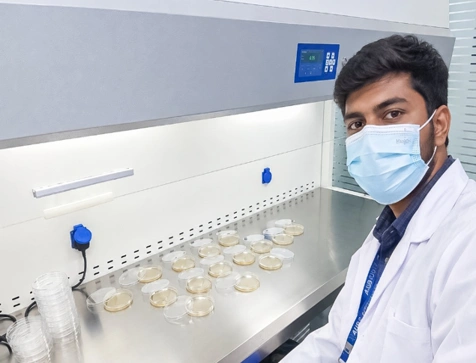
.webp)
Fig. 2: Biosafety Level 2 (BSL-2) Microbiology Laboratory
Key strengths
- Hands-on student training in microbiology, microscopy, microbial identification, GLP, biosafety, and laboratory quality practices.
- Automated microbial identification using the VITEK 2 Compact system.
- Research facilities for functional bioinnovation in probiotics, immunobiotics, AMR, food safety and beneficial microorganisms.
- Fermentation and product-development facilities, including fermenter/bioreactor, high-capacity centrifugation, freeze-drying, stability assessment, and packing and sealing.